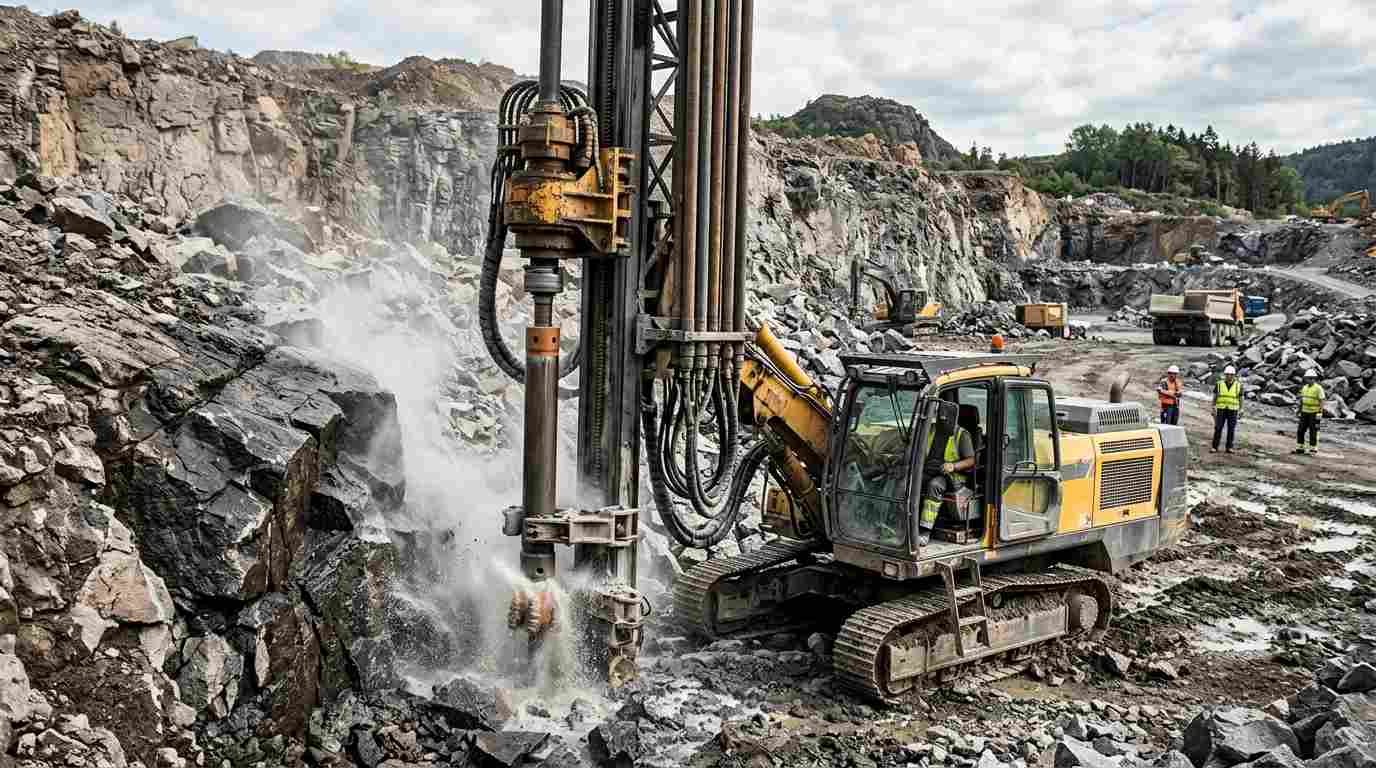
A DTH drilling rig (down-the-hole drilling rig) is a drilling machine where a pneumatic hammer is attached to the bottom of the drill string and delivers percussive blows directly at the drill bit, while compressed air both powers the hammer and flushes cuttings. DTH drilling is the method of choice for hard and fractured rock, whereas a rotary auger (rotary screw) excels in soft soil and loose ground. For solar farms and foundations that cross mixed geology, many contractors choose a 3-in-1 platform that combines DTH rock drilling, rotary auger soil drilling, and hydraulic pile ramming on one machine. Buyers evaluating a DTH drilling rig manufacturer or supplier should look at hammer compatibility, matched air-compressor sizing, and the vendor's ability to service the down-hole tooling — not just the rig price.
| DTH Best for hard / fractured rock |
Auger Best for soft soil & loose fill |
3-in-1 One rig: rock + soil + ram |
Air DTH powered by compressor |
1. What Is a DTH Drilling Rig?
Down-The-Hole (DTH) drilling places the percussion hammer at the bottom of the drill string, right behind the bit — hence "down the hole." Compressed air travels down the string to activate the hammer; the hammer strikes the bit to fracture rock, while the same air flushes cuttings up the annulus. Because the impact energy is generated at the bit rather than at the surface, DTH maintains high penetration efficiency even at depth and in hard formations.
Typical applications
- Mining, quarrying, and blast-hole drilling.
- Geotechnical and foundation boring.
- Water wells.
- Solar-farm rock drilling where piles must be drilled (not driven) into bedrock.
On PV sites where piles must be drilled into bedrock or dense rock, a DTH-equipped machine is often the only practical option. TeZhong's TZ536 3-in-1 platform integrates DTH drilling alongside hydraulic ramming and rotary auger on a single chassis.
2. How DTH Drilling Works (Step by Step)
- Position: The rig aligns the drill string over the target point.
- Rotate + push: The string rotates while downward feed pressure is applied.
- Percussive action: Compressed air fires the DTH hammer, which strikes the bit to break rock.
- Flush: Air blows cuttings up and out of the hole.
- Advance: Drill pipe is added as the hole deepens; the cycle repeats to target depth.
For solar foundations, the drilled hole then receives the pile (grouted or backfilled), or the same platform rams a pile where soil allows.
3. DTH Drilling Rig vs. Rotary Auger — Head-to-Head
| Factor | DTH Drilling Rig | Rotary Auger |
|---|---|---|
| Best geology | Hard rock, fractured rock, bedrock | Soft soil, clay, sand, loose fill |
| Cutting action | Percussive (hammer at bit) | Rotational screw conveying spoil |
| Power source | Compressed air (needs compressor) | Hydraulic rotation |
| Penetration in rock | Excellent | Poor — auger dulls/clogs |
| Penetration in soil | Works, but slower than auger | Excellent & fast |
| Typical use | Mining, rock foundations, PV on bedrock | Soft-ground foundations, bored piles |
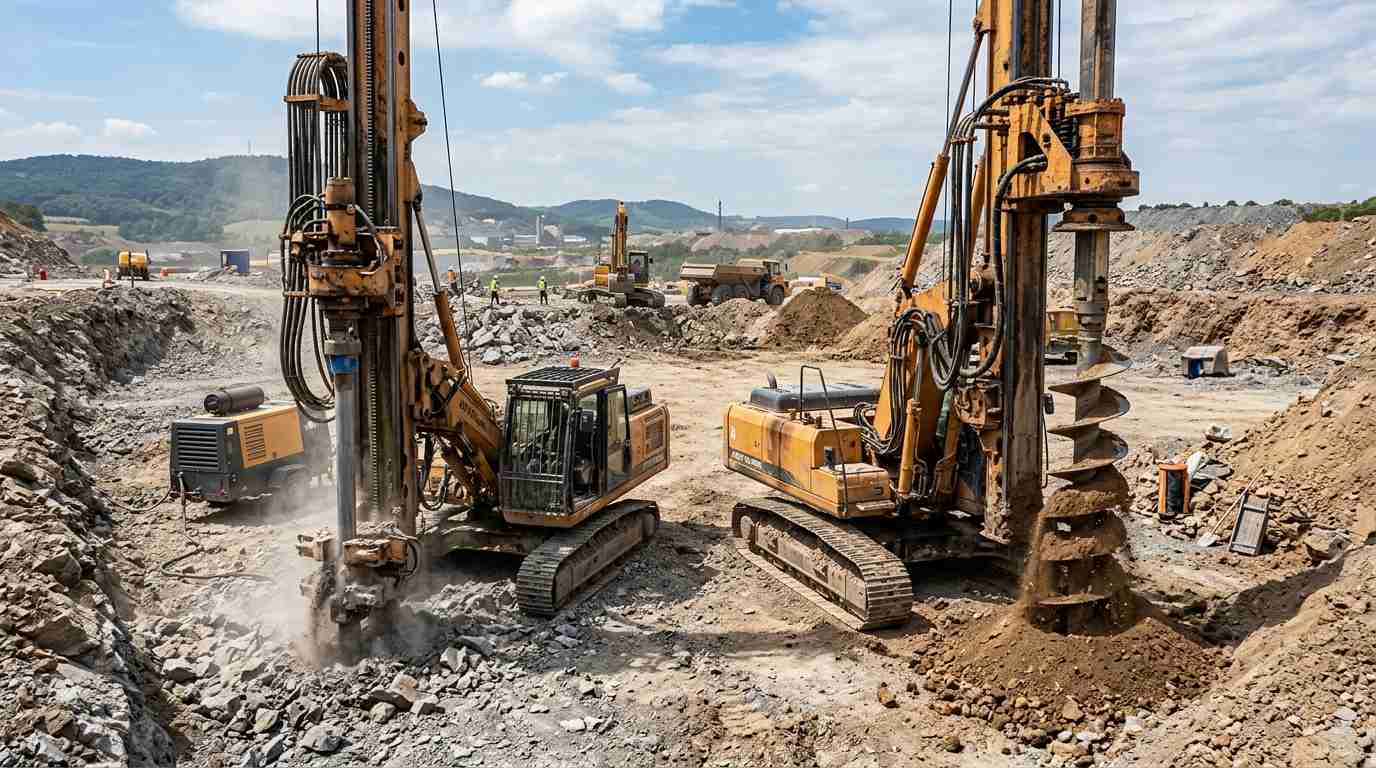
4. Key Components of a DTH Drilling Rig
- Top drive / rotary head — rotates the drill string and applies feed pressure.
- Drill string — pipes that transmit rotation and carry air down to the hammer.
- DTH hammer — the down-hole percussive unit that strikes the bit; sized by hole diameter.
- Bit — carbide-button bits matched to rock hardness and formation.
- Feed & clamp — advances and holds the pipe during make/break of joints.
- Air system interface — connects to the compressor delivering CFM/psi to the hammer.
Hammer and bit selection is the single biggest productivity lever. A mismatched bit in abrasive rock can cut penetration by half and wear out fast — which is why a serious rock drilling rig factory stocks and supports the full down-hole tooling range.
5. How to Choose the Right Drilling Method
| Checklist item | What to verify |
|---|---|
| Geology first | Run a geotech survey. Rock presence → DTH; uniform soft soil → auger. |
| Hole diameter & depth | Match rig capacity and hammer size to your pile/anchor spec. |
| Site mobility | Crawler for rough terrain; wheeled for graded parcels. |
| Air supply | DTH requires an adequate compressor (CFM/psi) — confirm the rig's air requirement. |
| Multi-function need | If the same crew does ramming + drilling, a combined platform reduces fleet cost. |
6. Why the Air Compressor Matters for DTH
DTH drilling is only as good as its air supply. A diesel rotary-screw air compressor delivers the volume (CFM) and pressure (psi) the hammer needs. Under-specify the compressor and penetration drops; over-specify and you waste fuel. TeZhong supplies diesel rotary-screw air compressors as companion units to its drilling rigs, so the air system is matched to the hammer from the factory.
| Symptom | Likely cause | Fix |
|---|---|---|
| Slow penetration | Low air volume / pressure | Upsize compressor CFM/psi |
| Hole not cleaning | Insufficient flush air | Increase air; check line losses |
| Premature bit wear | Wrong bit for formation | Match bit to rock type |
7. DTH for Solar Farm Foundations
Not every solar site can be driven. Where the design calls for piles into bedrock or where local rules require drilled foundations, a DTH drilling rig becomes essential. A 3-in-1 machine — combining solar pile driver ramming, DTH rock drilling, and rotary auger soil drilling — lets one unit handle an entire site regardless of subsurface variation. This is exactly why TeZhong's TZ536 is specified for geologically mixed utility-scale projects, including desert and mountainous solar farms.
8. DTH Beyond Solar: Mining & Water Wells
- Mining & quarrying: Production and presplit blast holes in hard rock; DTH gives straighter, cleaner holes than top-hammer at depth.
- Water wells: Boreholes through rock aquifers where auger cannot progress.
- Foundations: Bridge piers, tower bases, and anchors in rocky ground.
- Geothermal & exploration: Deep investigation boreholes in competent formations.
This breadth is why many contractors treat a DTH rig as a year-round asset rather than a single-project tool — the same hammer tackles solar rock, quarry blast holes, and water-well boring.
9. Market & Where to Source DTH Rigs
DTH equipment sits at the intersection of mining, construction, and energy. For buyers planning procurement or DTH hammer wholesale sourcing:
- Mining-led demand: Sustained metals demand keeps blast-hole DTH busy across Africa, Latin America, and Central Asia.
- Energy transition: Solar and wind foundations on rocky terrain push DTH into the renewables supply chain.
- Water security: Drought-driven well drilling sustains demand in arid regions.
- Sourcing shift: More buyers go direct to a DTH drilling rig OEM factory for matched hammer + compressor packages and spare-part continuity.
10. Common DTH Drilling Mistakes
- Under-specifying the compressor — the most common cause of slow, costly drilling.
- Wrong bit for the formation — premature wear and stalled penetration.
- Skipping the geotech survey — discovering rock too late triggers change-orders.
- Buying the rig without the tooling — hammer/bit spares become a bottleneck.
- Choosing on price alone — a DTH drilling rig supplier that supports the full air + tooling chain protects utilization.
11. Frequently Asked Questions
12. Case Study: Mixed-Geology Solar Farm
On a mountainous utility-scale solar project, a contractor faced alternating soft-soil benches and bedrock outcrops. Using TeZhong's TZ536 3-in-1 platform, the same crew switched between rotary auger (soft sections) and DTH hammer (rock sections) without mobilizing a second machine, then rammed piles where soil allowed. The single-chassis approach cut mobilization cost and kept a consistent foundation grid across the whole parcel — a workflow that direct from a guardrail pile driver and DTH OEM simplified for the operator.
TeZhong Machinery is a China-based DTH drilling rig manufacturer and supplier, building matched diesel rotary-screw air compressors and 3-in-1 platforms (ram + DTH + auger). As a direct rock drilling rig factory we configure to your geology and hole spec — tell us your requirements for a quote.